
From Falls to Future: The 100-Year Story of The Spinning Mill
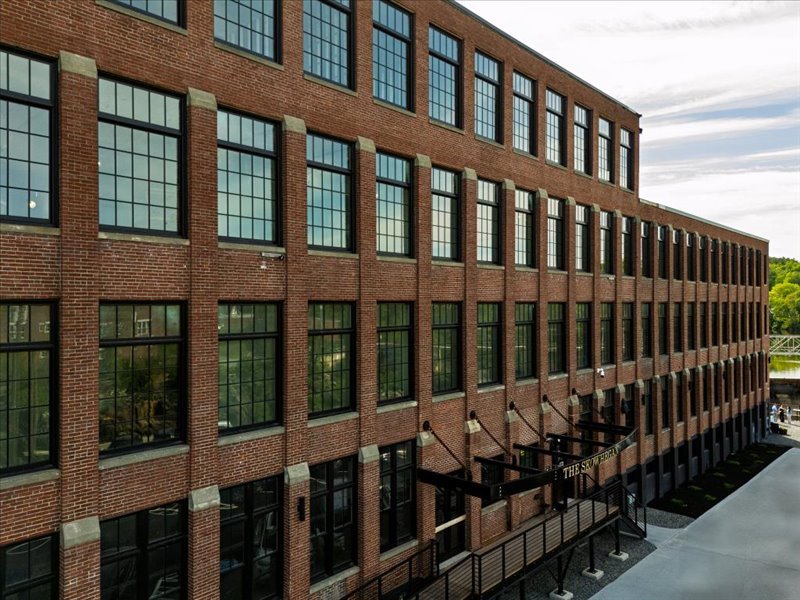
Every building tells a story. Most of those stories are quiet — decades of ordinary use, a renovation here, a coat of paint there. The Spinning Mill at 7 Island Avenue in Skowhegan, Maine tells a different kind of story. One that spans a century, includes a flood, a governor, and 300 workers making American flags.
This is the story of the building you're staying in.
Before the Mill: A Place to Watch
Long before there was industry on Skowhegan Island, there was the river. The Kennebec flows through a dramatic gorge here, creating falls that were among the most important fishing grounds for the Abenaki people. They called this place "Skowhegan" — a word meaning "a place to watch for fish." For thousands of years, this stretch of river was a gathering place, a food source, and a site of deep cultural significance.
By the late 1800s, the island had been transformed by industry. Mills, dams, and manufacturing operations lined the Kennebec, harnessing its power for production.

Construction: 1922
In 1922, the architectural firm Lockwood, Greene & Co. — one of the most prominent industrial designers of the era — began construction on a new spinning mill. The building was massive: reinforced concrete, steel framing, and wood plank floors and ceilings, designed to house the heavy machinery and hundreds of workers needed to turn raw fiber into yarn.
Opening Day: 1923
The mill opened in 1923 to remarkable public interest. Fifteen hundred people toured the new facility on opening day — a testament to what the building meant to the community. The project was featured in Building Age journal as a model of modern industrial construction.
Peak Operations: 1923–1970
For nearly fifty years, the mill was the heartbeat of Skowhegan's economy. At its peak, 300 workers produced two million pounds of yarn annually. The fibers they spun became military uniforms during wartime and American flags in peacetime. The operation was described as "a corporation with a soul" — an employer that was woven into the fabric of the community as deeply as the yarn was woven into its products.
Generations of Skowhegan families worked these floors. The building wasn't just a workplace — it was a social institution, an economic anchor, and a source of community identity.
Silence: 2005–2019
Like many New England textile operations, the Spinning Mill eventually closed. By 2005, the building fell silent. For fourteen years, it sat vacant on its island in the Kennebec — windows dark, machinery still, purpose gone. A local described it as "a stubborn reminder of where we were."
But the building held. The concrete didn't crack. The beams didn't fail. The river kept flowing past walls that were built to last.
Rebirth: 2019
In 2019, High Tide Capital, a Bangor-based development firm, acquired the mill and began a $20 million adaptive reuse project. The vision was ambitious: transform the vacant industrial landmark into a living community — 41 loft residences, a 20-room boutique hotel, over 10,000 square feet of event space, and a farm-to-table restaurant operated by Maine Grains.
The restoration respected the building's history. Original wood plank ceilings, oversized windows, and structural elements were preserved and celebrated. New systems — plumbing, electrical, climate control — were threaded through the old bones. The result is a building that honors its industrial heritage while serving an entirely new purpose.
The Flood: December 18, 2023
Just as The Skowhegan was finding its rhythm, the Kennebec delivered a reminder of its power. On December 18, 2023, a once-in-a-century storm pushed five feet of floodwater into the building. The damage exceeded $3 million. Governor Janet Mills toured the devastation.
For anyone who had watched the building's painstaking restoration, the flood was heartbreaking. Fourteen years of vacancy. A $20 million investment. And then five feet of water.
But Skowhegan has always been a place that rebuilds. High Tide Capital committed to restoring the building again. Work crews came through the winter. Contractors worked through the spring.
The Celebration: June 3, 2025
On June 3, 2025, Governor Mills returned to The Skowhegan — this time to cut a ribbon. The building was open. The hotel was welcoming guests. The Biergarten was serving food. The river was visible through the same windows that had been dark for a decade and a half.
From a vacant mill to a flood zone to a boutique hotel with a farm-to-table restaurant on the Kennebec River. That's not just a renovation story. That's a story about what happens when people refuse to give up on a place.
The Future
Today, The Skowhegan Hotel looks out over a river that's being reimagined. The Skowhegan River Park — Maine's first whitewater park — is under construction in the gorge below. Four lower Kennebec dams are being removed, returning Atlantic salmon to the river for the first time in over a century. And downtown Skowhegan, anchored by Maine Grains, Main Street Skowhegan's revitalization work, and the creative energy of a new generation, is becoming a destination rather than a pass-through.
The building at 7 Island Avenue has witnessed it all. And it's still here. Still standing on the river. Still watching.
Learn more about the hotel or book your stay.
